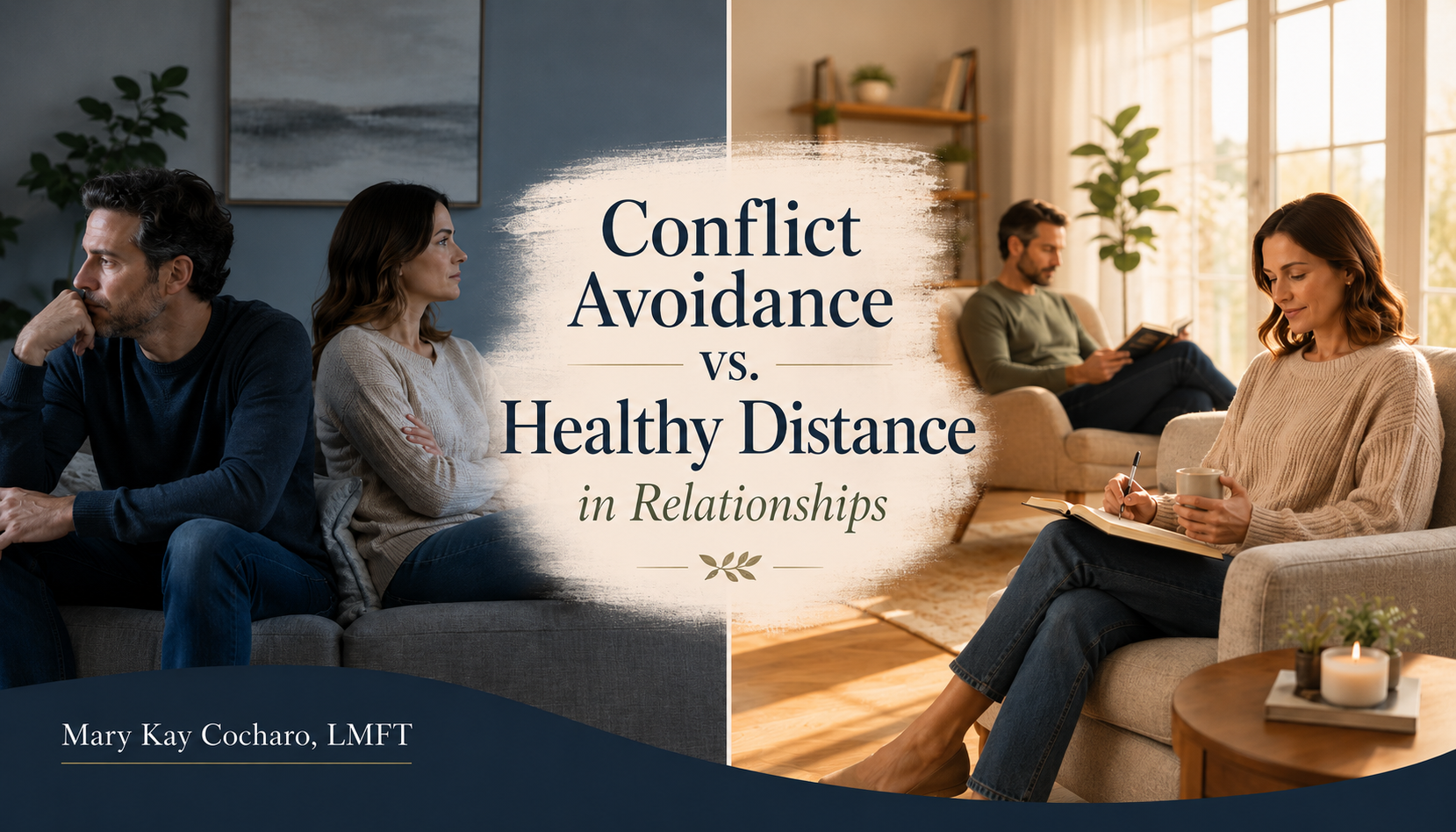
The Difference Between Conflict Avoidance and Healthy Distance in Relationships
Written by Mary Kay Cocharo, LMFT · California License #MFC 25394 · Licensed Marriage and Family Therapist with over 30 years of experience working with individuals, couples, and families in Los Angeles.

One of the most common things I hear from couples is some version of this: “I just need space when things get heated.” The partner sitting across from them usually interprets that as rejection, abandonment, or proof that the relationship does not matter. And the person asking for space often feels suffocated, misunderstood, and accused of something they did not intend.
Both people are telling the truth. And both are missing something important.
There is a real and clinically meaningful difference between healthy distance and conflict avoidance. Knowing which one is happening in your relationship is not a small distinction. It determines whether space is a tool for connection or a slow erosion of it.
In This Article
Two Things That Look the Same but Are Not
From the outside, conflict avoidance and healthy distance can look nearly identical. One partner steps back. Conversations get shorter. Difficult topics go untouched. The house feels quieter than it used to.
But what is driving that quiet matters enormously. Healthy distance is a deliberate, temporary regulation strategy used to protect both partners from a conversation that would be more harmful if it continued in that moment. Conflict avoidance is a chronic pattern of steering away from discomfort entirely; not to return to it later, but to make sure it never has to be faced at all.
The table below captures the core differences:
| Healthy Distance | Conflict Avoidance | |
|---|---|---|
| Intent | Regulate, then reconnect | Prevent discomfort permanently |
| Duration | Temporary and defined | Indefinite and recurring |
| Communication | “I need a break, I’ll come back to this” | Silence, topic changes, or shutting down |
| Effect on Trust | Builds safety over time | Erodes trust gradually |
| Underlying Feeling | Self-aware, protective | Fearful, conflict-phobic |
| Outcome | The conversation happens, eventually | The issue stays buried and grows |
The difference is not about how much space a person takes. It is about what that space is in service of.
What Healthy Distance Actually Looks Like
Healthy distance is grounded in self-awareness. A person using it knows they are flooded, overwhelmed, or approaching a point where they will say something they regret. They step back not to escape the relationship but to protect it.
In practice, healthy distance involves three things:
A clear signal. The person communicating the need for space says something, even briefly. “I’m getting overwhelmed, I need 20 minutes.” This is not a weakness. It is one of the most responsible things a partner can do in the middle of a hard conversation.
A genuine return. The pause has a purpose. The person who stepped away comes back to the topic when they are regulated enough to engage. The conversation is not abandoned, just postponed to a moment when both people can actually hear each other.
Mutual understanding over time. When healthy distance is used consistently and followed by genuine re-engagement, both partners begin to trust the pattern. The distance stops feeling like a threat and starts feeling like respect.
Research from the Gottman Institute supports this. When couples are physiologically flooded during conflict, their heart rates often exceed 100 beats per minute and their ability to think flexibly, listen accurately, or access empathy drops sharply. A structured break of at least 20 minutes, during which neither person ruminates on the argument, can allow the nervous system to return to a state where productive conversation is possible.
What Conflict Avoidance Actually Looks Like
Conflict avoidance looks like peace, but it is not peace. It is pressure that has nowhere to go.
The person practicing conflict avoidance is not taking a regulated break from a conversation. They are working, often without realizing it, to make sure that conversation never happens. Over time, the topics that cannot be touched multiply. The emotional distance grows. What began as an attempt to keep things calm slowly becomes the thing that is quietly ending the relationship.
In my clinical experience, conflict avoidance often comes from one of two places. The first is a learned response from a family of origin where conflict was dangerous, explosive, or deeply shaming. If you grew up in a home where arguments meant someone got hurt, it makes complete sense that your nervous system learned to treat all conflict as a threat to be neutralized. The second is a relational dynamic where one partner has made conflict feel costly. Criticism, contempt, or disproportionate emotional reactions from one partner can train the other to go quiet just to survive.
Neither origin makes conflict avoidance the other person’s fault. But both require honest attention.
When Distance Becomes Stonewalling
Stonewalling is what happens when conflict avoidance hardens into a wall. Dr. John Gottman identifies it as one of the four most destructive patterns in relationships, alongside criticism, contempt, and defensiveness. He calls them the Four Horsemen because, when all four are present and unaddressed, they predict relationship breakdown with striking accuracy.
Stonewalling is not always dramatic. It does not require slamming doors or walking out. It can look like:
- Giving one-word answers during an emotional conversation
- Suddenly becoming very interested in your phone
- Going through the motions of listening while being completely checked out
- Changing the subject every time a particular topic arises
- Responding to your partner’s distress with a flat, expressionless face
Key Insight
What makes stonewalling particularly painful for the receiving partner is that it communicates, at a very primal level, that they do not matter enough to engage with. Research shows that people on the receiving end of stonewalling experience elevated stress hormones, increased heart rate, and the same physiological response associated with social rejection. The body reads it as abandonment.
The partner who is stonewalling is often not being cruel. They are frequently flooded, overwhelmed, and doing the only thing that feels survivable in that moment. But the impact on the relationship is corrosive regardless of the intent.
Why This Distinction Matters in Couples Therapy
When I work with couples, one of the first things I try to establish is what kind of distance is operating in their relationship. This is not always obvious, even to the couple themselves. The person pulling back may genuinely believe they are protecting the relationship. The partner pursuing may genuinely believe they are being abandoned. Both can be right about their experience and wrong about what is actually happening.
Couples therapy creates a structure where that distinction can be made safely and honestly. In a supported setting, the withdrawing partner can begin to explore whether they are regulating or avoiding, and the pursuing partner can begin to understand that pressure often drives the very retreat they are trying to prevent.
In Imago Relationship Therapy, one of the modalities I am certified in, we work explicitly with the pursuer-withdrawer dynamic. Both roles are understood as adaptations, nervous system responses shaped by early experience, not as personality flaws or weapons. That reframe alone can shift something significant in a couple’s dynamic.
For couples where avoidance has been long-standing, a Private Couples Intensive can be especially valuable. Concentrated, uninterrupted time with a skilled therapist creates the conditions for conversations that have been avoided for years to finally happen in a way that feels safe enough to sustain.
Moving Toward Healthy Conflict
The goal is not to eliminate distance from a relationship. Some space is healthy, necessary, and a sign of two people who know themselves well enough to know when they need to pause. The goal is to make that space honest, boundaried, and in service of reconnection rather than avoidance.
If you recognize conflict avoidance in yourself or your partner, the most important first step is curiosity rather than criticism. Ask what the avoidance is protecting.
Ask what it would mean to have the conversation that keeps getting postponed. The answer is usually not laziness or indifference. It is almost always fear — and fear, unlike stonewalling, can be worked with.
If you are ready to bring more honesty and safety into your relationship, I invite you to schedule a free 15-minute consultation. The conversation you have been avoiding may be the one that changes everything.
Ready to Start the Conversation?
Schedule a free 15-minute consultation. The conversation you have been avoiding may be the one that changes everything.
About the Author
Mary Kay Cocharo, LMFT
California License #MFC 25394
Mary Kay Cocharo is a Licensed Marriage and Family Therapist with over 30 years of clinical experience working with individuals, couples, and families in Los Angeles. She holds advanced certifications in Imago Relationship Therapy and Encounter-Centered Couples Transformation, and has been named one of the Three Best Rated Therapists in Los Angeles for multiple consecutive years.
11500 West Olympic Boulevard, Suite 614, Los Angeles, CA 90064 · 310-828-2624
Frequently Asked Questions
What is the difference between conflict avoidance and healthy distance?
Healthy distance is a deliberate, temporary pause from a difficult conversation taken for the purpose of emotional regulation, with the intention of returning to the topic. Conflict avoidance is a chronic pattern of steering away from difficult topics entirely to prevent discomfort, with no intention or plan to revisit them. The key difference is intent and follow-through: healthy distance leads back to connection, while conflict avoidance leads to growing emotional distance.
What is stonewalling in a relationship?
Stonewalling is when one partner emotionally withdraws from an interaction entirely, refusing to engage, respond, or acknowledge the other person’s distress. It can look like silence, blank expressions, monosyllabic answers, or physically leaving. Dr. John Gottman identifies it as one of the four most predictive patterns of relationship breakdown. It is often a response to emotional flooding — meaning the person stonewalling is frequently overwhelmed rather than intentionally hurtful.
Is conflict avoidance the same as being introverted or needing alone time?
No. Introversion and the need for alone time are personality traits related to how people restore energy, and they have no direct relationship to conflict. Conflict avoidance is specifically about steering away from disagreement, tension, or emotionally charged conversations. An introvert can be direct, honest, and willing to engage in difficult discussions. A conflict-avoidant person may be highly social in non-threatening contexts but consistently retreat from relational friction regardless of their social energy.
Can conflict avoidance damage a relationship even if there is no arguing?
Yes, and often significantly. Relationships that appear calm on the surface because one or both partners systematically avoid conflict tend to accumulate unspoken resentments, unresolved issues, and a growing sense of disconnection. The absence of open conflict is not the same as the presence of intimacy. Over time, conflict-avoidant relationships often develop a kind of emotional flatness, where both partners feel lonely even though nothing overtly wrong seems to be happening.
How do I know if I am stonewalling or just needing space?
The clearest indicator is what happens after the pause. If you step away from a difficult conversation and return to it later when you feel more regulated, that is healthy distance. If you step away and the topic quietly disappears, resurfaces only to be avoided again, or never gets resolved across months or years, that pattern is more consistent with stonewalling or chronic avoidance. Another useful question is whether you communicate your need for space at all. A complete shutdown with no signal to your partner is more likely to land as stonewalling regardless of your internal intention.
What causes conflict avoidance in marriages?
Conflict avoidance in adult relationships most commonly traces back to one of two sources: a family of origin where conflict was associated with danger, shame, or emotional instability; or a current relationship dynamic where engaging in conflict has felt too costly, perhaps because of a partner’s critical or contemptuous responses. Both are understandable adaptations. Both can be worked through with skilled therapeutic support that helps the nervous system learn that conflict, handled well, is not a threat to the relationship but a path through it.
When should a couple seek therapy for conflict avoidance?
It is worth seeking professional support when the same topics keep being avoided over months or years, when one partner feels chronically unheard or dismissed, when emotional or physical intimacy has decreased alongside the conflict avoidance, or when attempts to raise difficult topics reliably end in shutdown rather than dialogue. These patterns tend to deepen over time rather than resolve on their own. A therapist can help both partners understand what is driving the avoidance and create the safety needed to finally move through it.
This article is written by a licensed clinician for educational purposes only. It does not constitute clinical advice, diagnosis, or treatment, and does not establish a therapeutic relationship.
 Deepen Emotional Intimacy