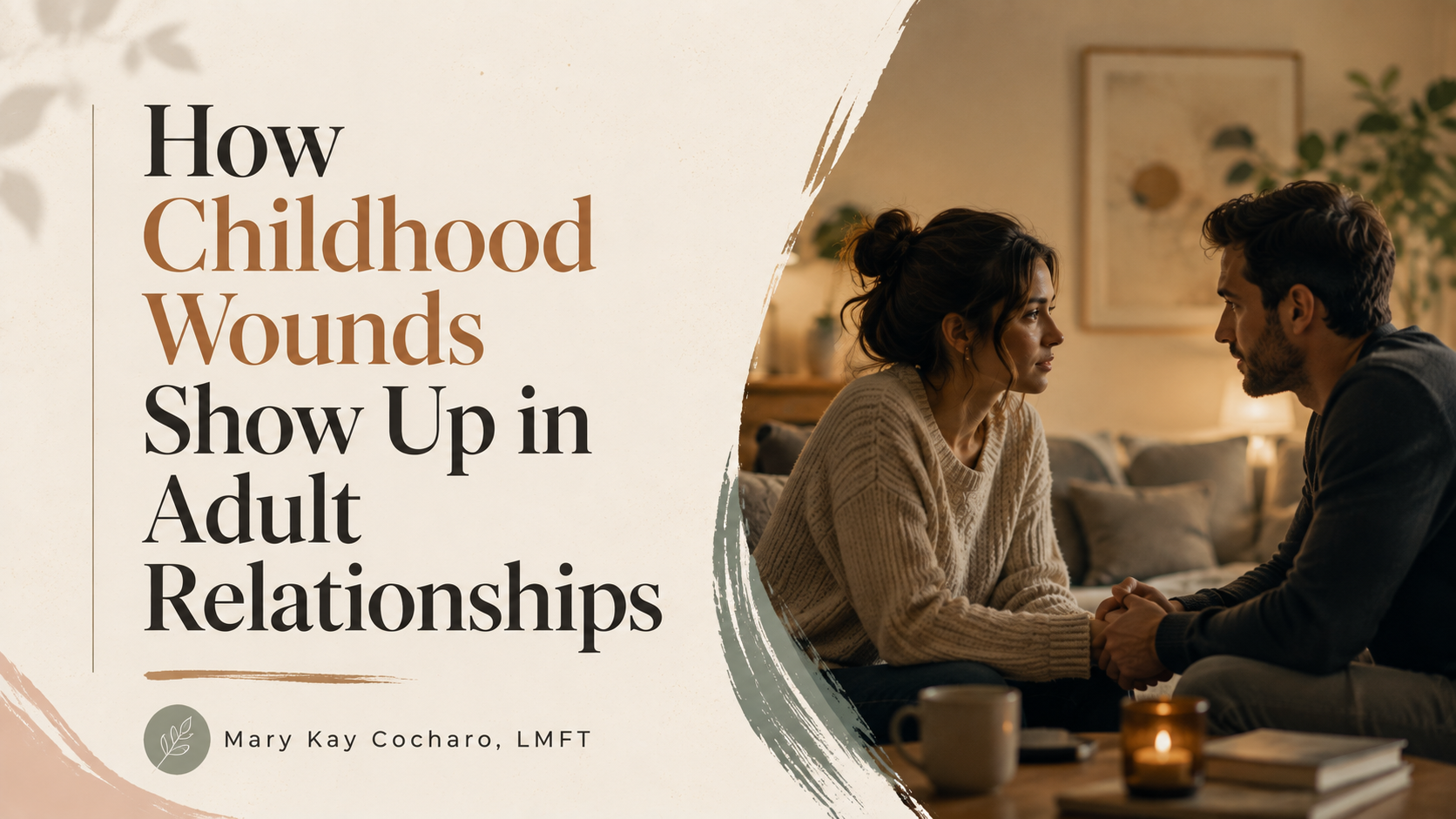
How Childhood Wounds Show Up in Adult Relationships
Written by Mary Kay Cocharo, LMFT · California License #MFC 25394 · Licensed Marriage and Family Therapist with over 30 years of experience helping individuals and couples work through childhood wounds in adult relationships in Los Angeles.

If you keep having the same fight with your partner, you are not alone: childhood wounds in adult relationships are one of the most common reasons couples feel stuck, and understanding the pattern is often the first step toward change.
There is a question I return to often in the therapy room, sometimes out loud and sometimes quietly to myself: why did these two particular people find each other?
Not in a romantic sense. In a clinical one.
After more than 30 years of sitting with couples, I have watched the same dynamic play out hundreds of times. Two people who genuinely love each other keep hurting each other in the same ways, over and over, often in ways that feel disproportionate to the actual event. A tone of voice that triggers a shutdown. A canceled plan that unleashes a depth of hurt that seems to have no bottom. A moment of criticism that lands like something far older and more devastating than the words themselves.
What is happening in those moments is not random. In many cases, it is childhood wounds in adult relationships resurfacing, showing up in the middle of an otherwise loving partnership. Understanding it through the lens of Imago Relationship Therapy is one of the most freeing things a couple can do.
In This Article
What Is Imago Relationship Theory?
Imago Relationship Theory was developed by Dr. Harville Hendrix and Dr. Helen LaKelly Hunt, first introduced in their landmark book Getting the Love You Want and later formalized into a therapeutic approach now practiced by certified Imago therapists worldwide. The word “imago” is Latin for image. It refers to the unconscious composite image each person forms in childhood of the people who raised them, specifically the emotional qualities, both the nurturing ones and the wounding ones.
The central premise is both elegant and, at first, uncomfortable: we do not choose our partners randomly. We are unconsciously drawn to people who carry the emotional signature of our earliest caregivers, because our psyche is trying, through the relationship, to finish what was left unfinished in childhood.
This is not dysfunction. It is biology and psychology working together toward healing. Without awareness, though, that drive toward healing can look a great deal like a drive toward suffering.
You can learn more about how I use this approach in my practice on the Imago Therapy page of my website.
The Imago Match: Why We Choose Who We Choose
The imago is assembled quietly, over the early years of life, out of everything a child absorbs about the people closest to them. It includes the ways love was expressed and the ways it was withheld. It includes the emotional temperature of the household, the patterns of connection and disconnection, and the messages a child received about their worth, their needs, and whether those needs were safe to express.
By adulthood, this imago is deeply encoded. It operates largely outside of conscious awareness, functioning more like a filter than a choice. Something activates that filter: a person’s presence, their energy, even the way they hold themselves. When it resonates with the imago, there is a powerful pull. Most people experience it as chemistry, as fate, or as simply knowing.
What they are often responding to, at least in part, is familiarity. And familiarity, when it comes to the imago, means both the gifts and the wounds of the people who shaped us.
This is why the traits that attract us to someone in the beginning so often become the traits that hurt us later. The partner who seemed so calm and steady in the early months may eventually feel emotionally unavailable. The partner who seemed so passionate and engaged may come to feel overwhelming or demanding. The qualities have not changed. What has changed is that the relationship has deepened enough for old childhood wounds to activate.
The Three Most Common Childhood Wounds in Adult Relationships
Every person’s history is unique, but Imago theory shows how childhood wounds in adult relationships tend to follow recognizable patterns. In my clinical experience, three wounds show up most often:
- The wound of abandonment. This develops when a caregiver was physically or emotionally absent, inconsistent, or unpredictable. As an adult, this wound often activates as intense anxiety around perceived rejection and a tendency to over-pursue when a partner pulls back. It can bring a deep terror of being left, one that makes ordinary distance feel catastrophic.
- The wound of engulfment. This develops when a caregiver was intrusive, controlling, or unable to allow the child appropriate separateness. As an adult, this wound often activates as a need for excessive autonomy, discomfort with emotional closeness, or a feeling of being suffocated by a partner’s needs, even when those needs are reasonable.
- The wound of shame. This develops when a child received consistent messages, spoken or unspoken, that they were too much, not enough, or fundamentally flawed. As an adult, this wound is often the engine behind defensiveness, the inability to receive criticism without collapsing, and the compulsive need to be right in conflict.
What makes the imago dynamic so potent is that people with complementary wounds tend to find each other. The person with an abandonment wound frequently partners with someone carrying an engulfment wound. Each person’s coping strategy perfectly activates the other’s deepest fear. The one who pursues triggers the one who withdraws. The one who withdraws triggers the one who pursues. And both feel, with complete sincerity, that the other is the problem.
The Power Struggle: Where Childhood Wounds in Adult Relationships Surface
Most couples who seek therapy are somewhere in what Imago theory calls the power struggle stage. The romantic stage, that early period of connection and joy, is real, but it is also partly neurochemical. The brain in early romantic love is flooded with dopamine and serotonin, and the imago match feels, in that stage, like coming home in the best possible sense.
Then the brain chemistry settles. The defenses come back up. And the old childhood wounds begin to surface.
The power struggle is not a sign that two people chose wrong. According to Dr. Harville Hendrix, it is actually a sign that the relationship has enough safety and depth for the real healing work to begin. The conflict, though painful, points directly at what needs attention.
Key Insight
The very person who triggers your deepest wounds is also the person most capable of helping you heal them, because they carry the relational template that your psyche recognizes.
This reframe is not easy to hold in the middle of a painful argument. But it is one that can change everything about how a couple understands what they are doing together.
How Childhood Wounds in Adult Relationships Show Up in the Therapy Room
When I work with couples using Imago Relationship Therapy, one of the first things I do is help each partner begin to see the connection between their current reactions and their earlier experiences. This is not about blaming parents or excavating the past for its own sake. It is about developing the kind of self-awareness that transforms reactivity into choice, which is often where childhood wounds in adult relationships become visible and workable rather than simply painful.
A partner who understands that their rage at being dismissed is connected to years of feeling invisible as a child can begin to communicate that need differently. Not as an attack, but as a longing. A partner who understands that their withdrawal is connected to a childhood where emotional closeness felt dangerous can begin to take small steps toward presence rather than simply disappearing.
The structured dialogue process at the heart of couples therapy creates the conditions for this kind of exchange. One partner speaks. The other mirrors back, validates, and empathizes, not because they agree with everything being said, but because they are choosing to meet their partner’s inner world with curiosity rather than defense. That experience, of being genuinely seen and heard by the person whose opinion matters most, is itself deeply healing. It begins to update the old story.
For couples where the wounds are longstanding or the patterns are deeply entrenched, a Private Couples Intensive can create the concentrated depth needed to move through material that weekly sessions approach more gradually.
You Did Not Choose Badly. You Chose Meaningfully.
One of the most important things I want couples to understand is that the imago match is not a mistake. It is not evidence that they are doomed or that they chose the wrong person. It is evidence that both of them are carrying something that wants to be healed, and that they found each other, in part, because healing was possible between them.
The relationship that triggers your deepest childhood wounds is also the relationship with the greatest potential for your deepest growth. That does not make it easy. It makes it worth understanding.
If you are ready to explore what your relationship is trying to teach you, I invite you to schedule a free 15-minute consultation. The patterns that feel most confusing often have the most to offer once they are understood.
Ready to Understand What Your Relationship Is Trying to Teach You?
A free 15-minute consultation is a no-pressure space to talk through what you are noticing before deciding on next steps.
About the Author
Mary Kay Cocharo, LMFT
California License #MFC 25394
Mary Kay Cocharo is a Licensed Marriage and Family Therapist with over 30 years of clinical experience working with individuals, couples, and families in Los Angeles. She holds advanced certifications in Imago Relationship Therapy and Encounter-Centered Couples Transformation, and has been named one of the Three Best Rated Therapists in Los Angeles for multiple consecutive years.
11500 West Olympic Boulevard, Suite 614, Los Angeles, CA 90064 · 310-828-2624
Frequently Asked Questions
What is Imago Relationship Theory?
Imago Relationship Theory is a therapeutic framework developed by Dr. Harville Hendrix and Dr. Helen LaKelly Hunt. It proposes that people unconsciously seek partners who carry the emotional characteristics of their earliest caregivers, both the nurturing qualities and the wounding ones. The goal of the relationship, from the psyche’s perspective, is to recreate the emotional environment of childhood in order to finish what was left unfinished. Imago therapy helps couples understand this dynamic and use it as a path toward mutual healing rather than ongoing conflict.
What is an imago match in relationships?
An imago match refers to the unconscious attraction between two people whose emotional wounds and coping strategies are complementary. A person who fears abandonment, for example, will often be drawn to someone with avoidant tendencies. This is not because they consciously seek pain. It happens because the nervous system recognizes the emotional signature of the early caregiving environment. Understanding the imago match helps couples stop experiencing their conflict as random and begin to see it as meaningful and workable.
Can childhood wounds in adult relationships be healed?
Yes, though not automatically. The relationship provides the relational context in which healing can happen, but it requires both partners to develop awareness of their patterns and a willingness to respond differently than their wounds trained them to. Imago Relationship Therapy provides specific tools, including structured dialogue, for creating the kind of interactions that update old emotional learning. The partner who once triggered a wound can, with intention and support, become the person who helps heal it.
Why do I keep attracting the same type of partner?
From an Imago perspective, this is the imago doing exactly what it was designed to do. The psyche is not drawn to what is comfortable. It is drawn to what is familiar, and familiar means whoever shaped our earliest understanding of love, connection, and self-worth. Until the underlying wound is addressed, the imago filter keeps selecting for the emotional patterns that resonate with it, regardless of how different partners appear on the surface.
What is the power struggle stage in a relationship?
The power struggle is the stage that typically follows the romantic phase of a relationship, when the neurochemical intensity of early love settles and both partners’ defenses and wounds begin to surface. It is often experienced as conflict, disappointment, and a sense that the person you fell in love with has changed. Imago theory reframes the power struggle not as a sign of incompatibility but as the beginning of the real work of the relationship, the point at which genuine healing and growth become possible.
How is Imago therapy different from regular couples therapy?
Imago therapy is a specific modality with its own structured approach. Its centerpiece is the Imago Dialogue, a carefully facilitated communication process in which partners take turns speaking and mirroring each other. The goal is genuine understanding, not debate. It places strong emphasis on the developmental origins of relational patterns and on the healing potential of the partnership itself. Not all couples therapy uses this framework. Therapists certified in Imago therapy have completed specialized training beyond a general therapy license.
Is it too late to work on childhood wounds in an adult relationship?
No. Neuroplasticity research confirms that the brain retains the capacity for new emotional learning throughout life. What was encoded in early childhood can be updated through consistent, safe, and attuned relational experiences, which is precisely what well-conducted couples therapy is designed to provide. Many of the most profound transformations I have witnessed in my practice have happened with couples in their 40s, 50s, and beyond.
This article is written by a licensed clinician for educational purposes only. It does not constitute clinical advice, diagnosis, or treatment, and does not establish a therapeutic relationship.
 Deepen Emotional Intimacy