Encounter-Centered Couples Therapy: Why It Transforms Relationships
Based on the pioneering work of Hedy Schleifer, Encounter-centered Couples Therapy (EcCT) offers a profoundly different way of working with couples. Unlike many approaches that focus solely on problem-solving or communication skills, EcCT is about creating a living, breathing connection — what we call “The Encounter”.
In EcCT, we don’t rush into conflict resolution. Instead, we create a safe, sacred space where two people can truly encounter one another — not just as partners, but as whole, complex, and beautiful individuals. This is work that is experiential, relational, and deeply human. We slow down, tune in, and listen not only with our ears, but with our hearts. In that environment, long-standing issues often soften, and new possibilities naturally emerge.
The Three Metaphors That Shape the Work
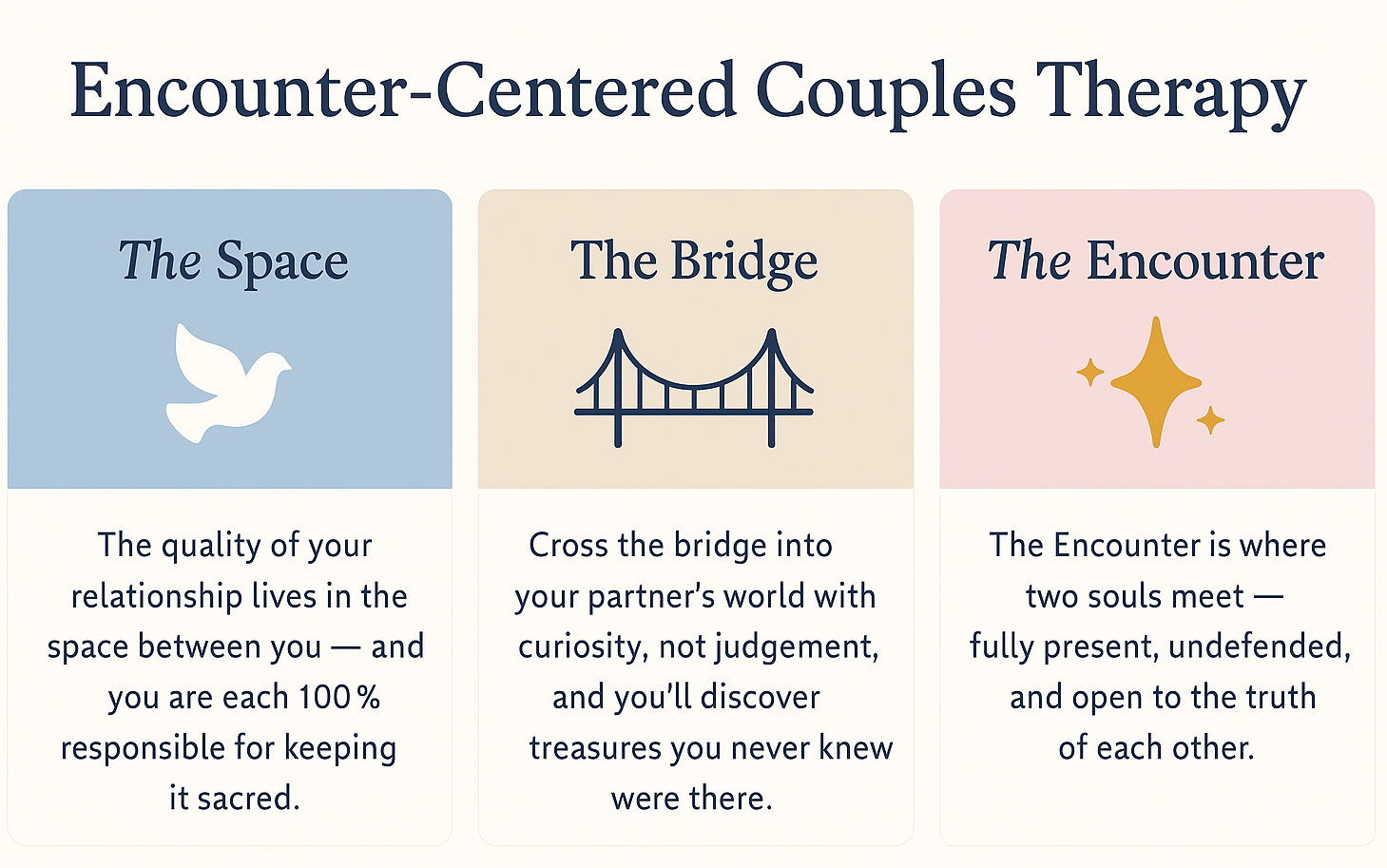
EcCT is anchored in three powerful metaphors that guide every step of the process:
-
The Space
Every relationship exists within a shared space — the invisible container where your connection lives. In EcCT, both partners are 100% responsible for keeping this space sacred. That means tending to it with kindness, respect, and care. When the space is safe and unpolluted, love and trust can breathe. When it’s filled with criticism, neglect, or resentment, even the strongest bond struggles. One of the first steps in EcCT is learning to honor and protect this space together.
-
The Bridge
Each partner lives in their own “world,” shaped by history, experiences, dreams, and values. The bridge is the path that allows you to visit the world of the other — not to judge it, fix it, or debate it, but to discover it with curiosity and an open heart. Walking across the bridge means setting aside your own perspective for a moment so you can truly listen, see, and understand the person you love. It’s an act of courage and generosity that builds trust and intimacy.
-
The Encounter
When the space is sacred and the bridge is open, you can arrive at the Encounter — that soul-to-soul meeting where both partners are fully present, undefended, and connected. In these moments, old wounds can soften, new understanding can bloom, and couples often experience a deep sense of “We.” It’s more than problem-solving; it’s a felt experience of love in its most alive and authentic form.
These three metaphors aren’t just concepts — they’re practices. Together, they create a living framework that helps couples move from disconnection to a relationship that feels vibrant, resilient, and deeply nourishing.
Stories of Real Transformation
From Roommates to Lovers Again
One couple came to me feeling more like roommates than romantic partners. Years of parenting, careers, and responsibilities had dulled their spark. Through EcCT, they began by cleaning and protecting The Space Between — becoming mindful of small criticisms or dismissive tones that polluted it. Then they practiced crossing the bridge into each other’s worlds, learning about hopes, fears, and dreams they hadn’t shared in years. Finally, they experienced The Encounter: a tender moment of hand-holding and eye contact where they truly saw each other again. That moment lit the first spark of renewed affection — and it has been growing ever since.
From Conflict to Curiosity
Another couple, worn down by years of unresolved arguments, arrived in therapy ready to call it quits. Instead of rehashing the same conflicts, they learned to care for The Space Between by pausing before speaking and checking if their words would keep it safe. They built the courage to cross the bridge into each other’s experiences, listening without judgment. In sessions, they reached The Encounter — an exchange of vulnerability and appreciation that shifted their marriage from a battleground into a place of mutual discovery. The issues didn’t disappear overnight, but the way they faced them transformed completely.
Why This Work Changes People’s Relationships
EcCT invites couples to become the guardians of their connection. It’s not just about learning new skills — it’s about creating a new way of being together. When partners commit to protecting the space, walking the bridge, and meeting in genuine encounters, the relationship doesn’t just improve; it comes alive.
As Hedy Schleifer often says, “We are each 100% responsible for the space between us.” When we tend to that space with care, we discover that transformation isn’t only possible — it’s inevitable.
In the end, Encounter-centered Couples Therapy is not just about repairing a relationship — it’s about renewing the very essence of connection. When two people dare to slow down, to truly meet in the space between, they rediscover not only each other, but themselves. And in that meeting place — tender, alive, and full of possibility — love doesn’t just survive, it thrives!
 Deepen Emotional Intimacy
Leave a Reply